Pohang Bogyeongsa Five-Story Stone Pagoda to Be Designated as a National Treasure
Notable for its sculptural techniques symbolizing reliquary beliefs and features like the drip-cut groove reflecting the stylistic characteristics from the Unified Silla to Goryeo periods.
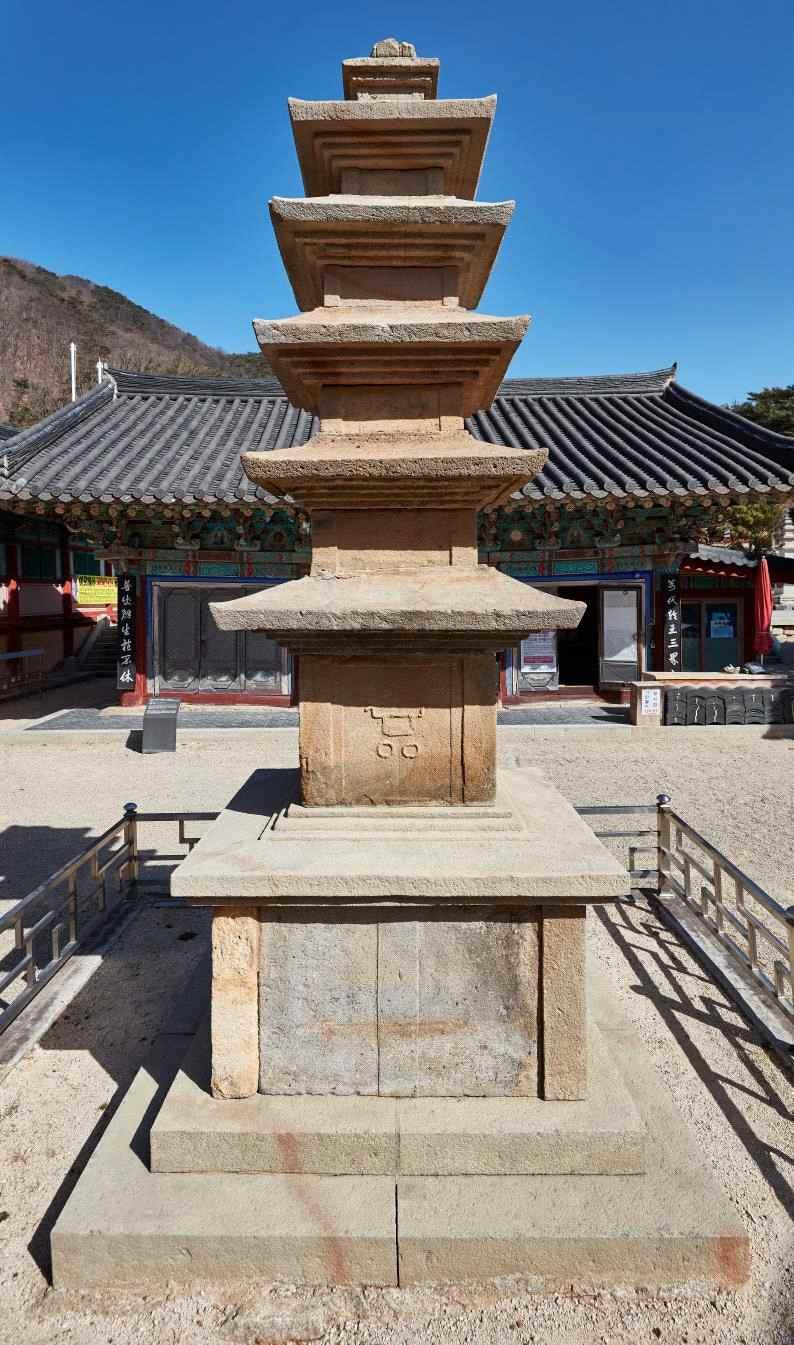
The Cultural Heritage Administration (CHA) led by Director Choi Eung-chun has announced the preliminary designation of the Pohang Bogyeongsa Five-Story Stone Pagoda (浦項 寶慶寺 五層石塔) as a National Treasure.
The Pohang Bogyeongsa Five-Story Stone Pagoda is located in front of the Jeokgwangjeon Hall within the Bogyeongsa Temple complex in Pohang. The pagoda stands approximately 4.6 meters tall and consists of a five-story pagoda body (塔身石 body stone) and roof stones (屋蓋石 roof stones) resting on a single-layer base with the finial (相輪部) composed of a square stone (露盤石 lower pedestal stone) and an inverted bowl-shaped stone (覆鉢石 upper pedestal stone).
Finial (相輪部): The decorative structure placed at the top of a stone pagoda.
Noban-seok (露盤石): The square stone that forms the base of the finial on a pagoda.
Bokbal-seok (覆鉢石): An inverted bowl-shaped stone placed on top of the noban-seok as part of the finial.
According to the Naeyeonsan Bogyeongsa Geumdangtapgi (內延山寶慶寺金堂塔記) written by the Buddhist monk Samyeong in 1588 the pagoda was constructed in 1023 during the 14th year of King Hyeonjongs reign in Goryeo because the temple lacked a pagoda leading to the creation of a five-story pagoda made of bluestone.
The first-story body stone prominently features carvings of a door frame lock and handle symbolizing the presence of a reliquary inside the pagoda. This carving technique which began in stone pagodas and stupas of the Unified Silla period and continued into the Goryeo period represents the Buddhist belief in reliquaries serving as a tribute to the teachings and spirit of Buddha.
Munbi-hyeong (門扉形): The shape of a door or window panel that fits into a frame used as a decorative element.
Additionally the underside of the first and second roof stones has a drip-cut groove designed to prevent rainwater from flowing into the body of the pagoda. This feature along with the carvings on the first-story body stone is also observed in other 11th-century pagodas like the Five-Story Stone Pagoda of Gaesimsa Temple Site in Yecheon (National Treasure) and the Five-Story Stone Pagoda of Jeongdosa Temple Site in Chilgok (National Treasure) showcasing the stylistic characteristics of early Goryeo stone pagodas that originated in the Unified Silla period.
Drip-cut groove: A groove carved to prevent rainwater from flowing into the body of the pagoda.
The Pohang Bogyeongsa Five-Story Stone Pagoda holds significant historical and scholarly value due to its clear documentation of the construction period and its demonstration of the typical construction techniques and styles of 11th-century stone pagodas.
The Cultural Heritage Administration will gather public opinions on the proposed designation of the Pohang Bogyeongsa Five-Story Stone Pagoda for 30 days after which it will undergo review by the Cultural Heritage Committee before being officially designated as a National Treasure. The CHA remains committed to actively discovering preserving and transmitting cultural heritage with historical and cultural value through systematic efforts.
Website: : http://www.wip-news.com/news/articleView.html?idxno=24592