The U.S. Patent Statute makes it an infringing act to export component parts outside the U.S. for the purpose of combining those parts in an infringing way
Kent A. JORDAN Judge of the United States Court of Appeals for the Third Circuit ‘The Supreme Court’s decision in WesternGeco’ changed our understanding of damages related to foreign losses for patent infringement

Kent A. JORDAN Judge of the United States Court of Appeals for the Third Circuit
The 2020 International IP Court Conference an international exchange event of the professionals in the IP field consisting of five sessions which are status of international trials high technology and patent eligibility major issues in design litigation cross-border patent infringement and mock trials has been ended successfully on November 12.
In the session 4 the fourth program in the conference the discussion on ‘Cross-border issue in IP infringement’ enacted among the speakers from Germany China the U.S.A. Japan and Korea.
Kent A. JORDAN attending through online was appointed in 2006 to serve as a United States Circuit Judge for the Third Circuit by President George W. Bush. Before the appointment he worked as a district judge in District of Delaware Court for 2002-2006. He received a Bachelor of Arts (B.A.) in Economics in 1981 from Brigham Young University and a Juris Doctor (J.D.) in 1984 from Georgetown University. After that he worked as a law clerk for Judge James L. Latchum of the Delaware District Court and as a lawyer specializing in intellectual property and business at Wilmington Law Firm in Delaware before becoming a judge.
Q : The US Supreme Court in WesternGeco LLC vs. ION Geophysical Corp. ruled that where Section 271(f)(2) of the US Patent Act applies lost foreign profit may be recovered in accordance with Section 284 of the US Patent Act. Will this holding have any implications on cases where Section 271(a) of the US Patent Act applies? In particular does WesternGeco undermine the validity of the holdings of the Federal Circuit’s decisions in Power Integrations Inc. vs. Fairchild Semiconductor International Inc. Ruling that damages based on lost foreign profit may not be awarded and Carnegie Mellon Univ. v. Marvell Tech. Grp. Ltd.78 Rejecting claims for reasonable royalties for acts taking place overseas?
A : As you will recall from the discussion of extraterritorial infringement section 271(f) of the U.S. Patent Statute makes it an infringing act to export component parts outside the U.S. for the purpose of combining those parts in an infringing way.
Recently in a 2018 case called WesternGeco the U.S. Supreme Court explained that when this type of infringement is found damages can include lost foreign profits. The Supreme Court overturned the Federal Circuit which had understood the presumption against extraterritorial enforcement of patent rights to preclude recovering profits for such sales as they did not occur in the U.S.
The Supreme Court reasoned that the patent statute’s focus was still on the domestic conduct it is regulating namely the act of shipping out component parts with intent to cause infringement and that the infringement damages should therefore award “Complete compensation” for that domestic act of infringement which would include lost international profits.
WesternGeco only mentioned section 271(f) infringement and left unstated the impact of foreign sales on other forms of infringement. That issue was subsequently raised in Power Integrations v. Fairchild.
In 2013 the Federal Circuit had not allowed worldwide sales as lost profits for Power Integrations based on the argument that Fairchild’s purely U.S. infringement caused lost sales for Power Integrations both in the U.S. and abroad.
Power Integration had argued under a “Foreseeability” basis they should be entitled to “Full compensation” and the Federal Circuit had rejected that argument writing that patent law does not “Provide compensation for a defendant’s foreign exploitation of a patented invention.” It ruled that the foreign production use or sale is an “Independent intervening act that under almost all circumstances cuts off the chain of causation” for damages purposes.
Because that decision predated WesternGeco in 2018 Power Integrations argued to the District of Delaware that the Federal Circuit’s decision in its 2013 case was overruled and asked the court to reinstate the jury verdict based on international lost sales.
My greatly respected friend Chief Judge Leonard Stark agreed writing that “The Supreme Court’s WesternGeco decision implicitly overruled the Federal Circuit’s Power Integrations opinion.”
WesternGeco had been based on section 271(f) infringement which as I mentioned involves shipping components overseas to be combined whereas Power Integrations v. Fairchild was based on section 271(a) which involves completing the act of infringement in the U.S. but Chief Judge Stark found no justification for distinguishing the two provisions in the context of damages.
With an appeal still pending before the Federal Circuit the parties settled their dispute in October last year leaving the question unanswered by the Federal Circuit.
WesternGeco has only been cited twice by the Federal Circuit and never in relation to issues of extraterritorial damages.
Lower courts have predominantly gone the same route as the District of Delaware with the Eastern District of Texas and the District of Wisconsin agreeing with Chief Judge Stark.
The Southern District of New York has extended the available remedy for worldwide damages to reasonable royalties which take into account lost international sales.
However Judge MaryEllen Noreika also a federal judge in Delaware found equitable relief limits to the WesternGeco doctrine holding that “An injunction is not an available remedy when the sole purported irreparable harm caused by infringement occurs in another country and the patentee asserts infringement only under § 271(a).”
The Northern District of California noted that there remains an evidentiary burden to prove the asserting party would “Have received profits in foreign countries but for infringement.”
Finally in another decision in disagreement with Chief Judge Stark’s ruling the Northern District of California found the opposite that damages cannot be sought for “Wholly foreign sales” under 271(a) unlike 271(f).
The Judge in that case concluded that it was significant that the Supreme Court had declined to grant certiorari in the 2013 Power Integrations case after the Federal Circuit had denied international lost profits which she interpreted to imply that WesternGeco is limited to 271(f).
The Federal Circuit certified an interlocutory appeal from that court on January 30 2020 which will likely provide opportunity to resolve this issue of lost profits for foreign sales under 271(a).
As you can likely tell from this body of case law and recent activity the Supreme Court’s decision in WesternGeco changed our understanding of damages related to foreign losses for patent infringement. Courts are still working out the contours of this decision with the Federal Circuit likely to weigh in soon but one principle remains consistent that infringement must remain within or directed at the United States. The change wrought by WesternGeco relates to the scope of the damages calculated as a result of that infringement.
This conference held on November 12 2020 was held at the Grand Hyatt Hotel in Seoul under the theme of Court IP and Globalization with the method using parallel online and offline to prevent the spread out of Covid 19.
Focusing on IP5 which are United States China Japan and Germany about 300 IP related professionals from 8 nations around the world participated online and offline to share and progress IP issues with various cases.
The 2020 International IP Court Conference was ended in great success raising the status of the IP international trial in Korea covering five sessions and mock trials.
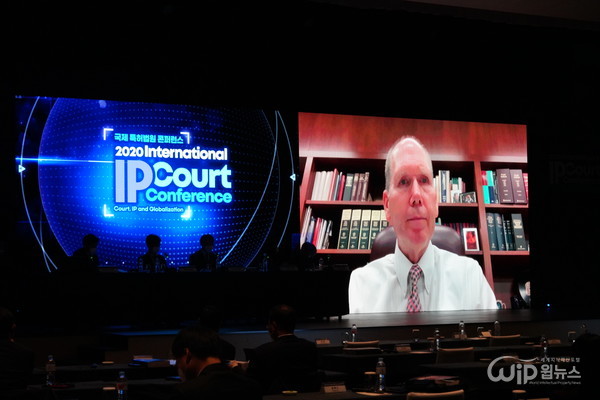
Photo of participating the live venue
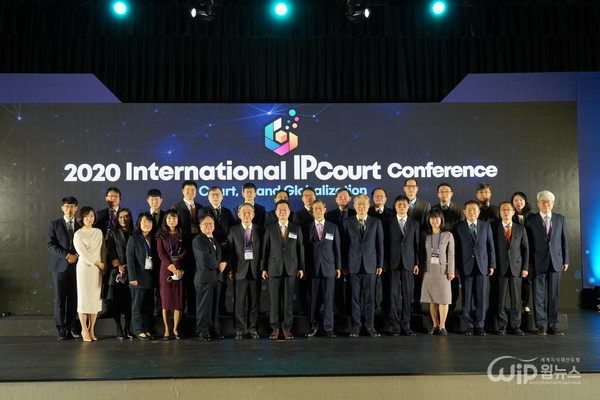
2020 International IP court conference commemorative photo
Website: : https://www.wip-news.com/news/articleView.html?idxno=5906