Development of plasma jets basic technology
Reduces liquid surfaces instability by using ‘Plasma bullet’

(From the left) Prof. Won-ho Choi Department of Nuclear & Quantum Engineering and Sang-hoo Park PhD in Physics graduate student [Photo provided = KAIST]
Prof. Won-ho Choi’s research team at the Department of Nuclear and Quantum Engineering at KAIST announced on the 2nd that they discovered that *plasma ionized gas increases the hydrodynamic stability of the interface between gas and liquid for the first time and succeeded in identifying it.
☞ Plasma : It refers to the state that a gas is heated with high energy and separated into electrons and ions that obtain electric charge. It plays an important role in the manufacturing process of semiconductors and displays and can be applied to fluorescent lights neon signs and air purifiers.
Prof. Chois research team found that when plasma obtained by ionizing helium gas jets at high voltage is sprayed on the surface of water the interface is much more stable than the general interface between ordinary gas and liquid. This is expected to be great help to basic science and applications that utilize plasma jets and widen the understanding of the natural interaction between weak ionized gases and liquids.
The research results that Dr. Sang-ho Park (Doctorate graduation in Physics in KAIST) in Korea Institute of Fusion Energy participant as the lead author and Prof. Choi as the corresponding author published in international academic journal ‘Nature’ on April 1st. (The title : Stabilization of liquid instabilities with ionized gas jets)
Irregular patterns such as water flow from a shower used at homes tears of wine and wave patterns on mud flats often show hydrodynamic instability showing at the fluid interface.
When we put a straw on the surface of a glass of juice and blow the surface of the juice the surface is dimpled concavely and when we blow harder the juice bubbles and drops of water spring up. It is because the instability of interface between air and juice.
Besides the jet-formed structure spraying the air on the liquid surface is actively used in various scientific and industrial technologies and has attracted continuous academic interest due to various interesting physicochemical phenomena.
However like the example mentioned above there was a lack of understanding of the phenomenon of increasing hydrodynamic instability on the liquid surface where gas jets were sprayed and how to stabilize them. Therefore despite the high level of interest there was a limit on increasing utilization.
Prof. Chois research team found out through experiments and theories that plasma created by ionizing gas jets into a strong electric field can improve the stability of the interface between gas and liquid.
Generally surface instability increases from liquids placed in a strong electric field environment such as raindrops in thunderclouds. A typical example of destabilization is a Taylor cone phenomenon that appears as a result of electro hydrodynamic instability from electro spinning.
The plasma jet used by Prof. Chois research team produces high-speed ionization waves and electric winds called ‘Plasma bullets’ but the research team was able to reduce the instability of the liquid surface by utilizing these characteristics.
The research team experimentally confirmed that although it should be a condition that the electric wind which the speed is tens of meters per second when plasma is generated inside the gas jet increases the force applied to the liquid surface and dig more deeply causing the liquid surface to become unstable but it maintains its stability.
The research team established a plasma-hydraulics theory model and discovered for the first time that the liquid surface is maintained stably by a strong electric field caused by plasma bullets moving tens of kilometers per second alongside on the liquid surface.
Plasma jets used by the research team have been used for various purposes in various interdisciplinary research fields recently.
Prof. Choi said The results of this research will enhance the scientific understanding of plasma and expand the field of plasma fluid control that can be utilized economically and industrially” and “It will contribute greatly to the development of technologies in various fields such as plasma medicine bio agriculture food and chemistry.
Meanwhile the research was conducted with the support of the National Research Foundation of Koreas ‘Personal Research Support Project (Excellent rising research)’ and KAISTs ‘High-Risk and High-Return Project’ and with academic support from KAIST Mechanical Engineering prof. Hyung-soo Kim and Prof. Choong-sik Bae.
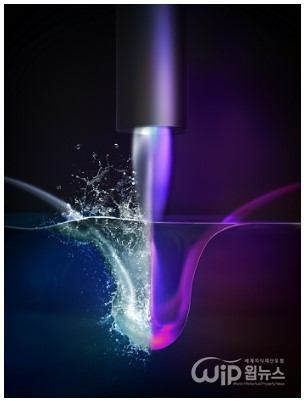
The illustration describing the stability of the liquid surface by ionization of gas jets [Photo provided = KAIST]
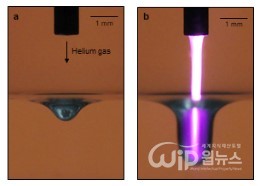
The Experimental photography showing the changes of liquid surface depending on plasma creation status [Photo provided = KAIST]
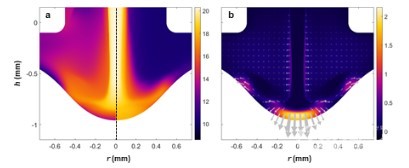
The characteristics of plasma near liquid surface calculated by plasma theory model [Photo provided = KAIST]
Website: : http://www.wip-news.com/news/articleView.html?idxno=6199