The U.S.A. says if there is a direct infringer and a company offering elements of patented inventions indirect infringement can be validated
Dmitry KARSHTEDT a professor at George Washington University Law School ‘The importation of the product made by the patented process was liable even if multiple entities were involved in carrying out the method patents process overseas’

Dmitry KARSHTEDT a professor at George Washington University Law School the U.S.A.
The 2020 International IP Court Conference an international exchange event of the professionals in the IP field consisting of five sessions which are status of international trials high technology and patent eligibility major issues in design litigation cross-border patent infringement and mock trials has been ended successfully on November 12.
In the session 4 the fourth program in the conference the discussion on ‘Cross-border issue in IP infringement’ enacted among the speakers from Germany China the U.S.A. Japan and Korea.
Professor Dimitry KARSHTEDT who participated through online teaches patent law in George Washington University Law School and his treatises are cited and included in U.S.A major textbook about intellectual property. Before being appointed as a professor he completed a Ph.D. in chemistry from U.C. Berkeley and worked as a staff scientist for a semiconductor materials startup and file an application of related 20 patent and 5 science thesis. Also he received his law degree from Stanford Law School and is in charged of top symposium editor of Stanford Law Review. After the graduation he worked as law clerk of Moore judge of CAFC Kimberly A and before the moving to George Washington University worked as a fellow at the Law and the Biosciences center of Stanford Law school.
Q : Assuming that all the acts of practicing a patent registered in your country take place within the territory of your country if the patent is infringed by multiple entities who will be liable for the infringement among the multiple entities? Please introduce judicial precedents or relevant discussions.
A : For method patents this scenario is controlled by Akamai Technologies Inc. v. Limelight Networks Inc. 797 F.3d 1020 (Fed. Cir. 2015) (en banc). Steps performed by other parties are attributable to the defendant “(1) Where that entity directs or controls others’ performance and (2) Where the actors form a joint enterprise.”
The first prong is satisfied where the defendant acts through an agent (applying traditional agency principles) or contracts with another to perform one or more steps of a claimed method or under principles of vicarious liability: when it conditions participation in an activity or receipt of a benefit upon performance of a step or steps of a patented method and establishes the manner or timing of that performance.
The second prong is satisfied when there is “(1) An agreement express or implied among the members of the group; (2) A common purpose to be carried out by the group; (3) A community of pecuniary interest in that purpose among the members; and (4) An equal right to a voice in the direction of the enterprise which gives an equal right of control.”
For product patents the direct infringer is one who puts the system into operation and obtains a benefit from it. See Centillion Data Systems LLC v. Qwest Communications Int’l Inc. 631 F.3d 1279 (Fed. Cir. 2011) and compare NTP. The court further explained that the direct infringer such as a customer or end user must obtain a benefit form each and every element of the claimed system.
Intellectual Ventures I LLC v. Motorola Mobility LLC 870 F.3d 1320 (Fed. Cir. 2017). As long as there is a directly infringing user the entity providing parts of the invention for assembly that the user then puts into operation can be an indirect infringer under § 271(b) or (c).
A different rule applies to infringement under § 271(g) the “product-of-foreign-process” provision. In Syngenta Crop Protection LLC v. Willowood LLC 944 F.3d 1344 (2019) the Federal Circuit reversed a lower court’s holding that this provision required that “all steps of a patented process be performed by or at the direction or control of a single entity” under Akamai. The court explained that “acts that give rise to liability under § 271(g) are the importation offer for sale sale or use within this country of a product that was made by a process patented in the United States.”
The court further noted that “[n]othing in this statutory language suggests that liability arises from practicing the patented process abroad. Rather the focus is only on acts with respect to products resulting from the patented process.” Accordingly the importation of the product made by the patented process was liable even if multiple entities were involved in carrying out the process abroad. At the time of this writing (September 30 2020) petition for a writ of certiorari in this case is pending before the Supreme Court.
This conference held on November 12 2020 was held at the Grand Hyatt Hotel in Seoul under the theme of Court IP and Globalization with the method using parallel online and offline to prevent the spread out of Covid 19.
Focusing on IP5 which are United States China Japan and Germany about 300 IP related professionals from 8 nations around the world participated online and offline to share and progress IP issues with various cases.
The 2020 International IP Court Conference was ended in great success raising the status of the IP international trial in Korea covering five sessions and mock trials.

Photo of participating the live venue
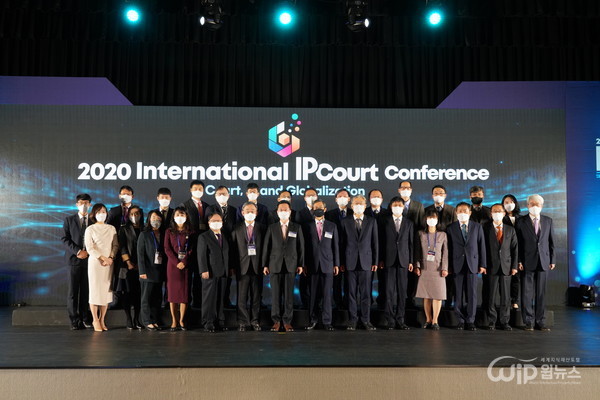
2020 International IP court conference commemorative photo
Website: : https://www.wip-news.com/news/articleView.html?idxno=5282