Observation of infinitesimal microplastic detection and cohesive behavior in water
Development of ultra-high sensitivity unlabeled light-electric fusion tong technology Underwater fine particles of 1ppm level are detected by underwater amplification of terahertz radiation
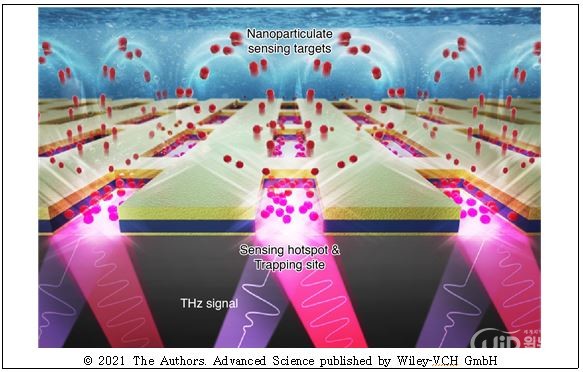
Ultra-high sensitivity light-electric fusion tongs using dual metal electrode structure (Figure provided = Korea Institute of Science and Technology Seo Min-ah Yoo Yong-sang/National Research Foundation of Korea)
Tongs that can detect fine materials ranging from dozens to hundreds of nanometer size such as microplastics or biopolymers and nano-light tweezer technology which have sensor function of analyzing quantitative and qualitative in real time were introduced.
It is expected that an electric tongs which is a light tongs not a mechanical tongs using principle of the lever and light sensors that use specific wavelengths of light will provide a new way to detect micro materials in water or biomarkers in liquid samples such as blood and body fluids.
The National Research Foundation of Korea (President Roe Jung-hye) announced that the research team of Dr. Seo min ah and Yoo yong sang at the convergent graduate school of KU-KIST (Korea University - Korea Institute of Science and Technology) has developed a new concept of light-electric tongs that combines nanoparticle collection and terahertz radiation amplification technology.
Terahertz radiations (Electromagnetic radiation that vibrate 1 trillion times per second) have very long wavelengths and low light-energy so they are harmless to the human body and are used for nondestructive testing.
However due to the characteristics of the terahertz radiations that is mostly absorbed to water and the low sensitivity to small amounts of material it was not used at all for the research to detect and analyze underwater microorganisms.
For this reason the research team proposed a method to increase sensitivity to dozens to hundreds times through signal amplification while preventing signal loss in water.
The main point is integrating the light high sensitivity light sensor using terahertz radiation change amplified by meta surface and electric tongs technology collecting infinitesimal nanoparticles into one.
It uses the changing principle of terahertz radiations or resonance frequency that changes through refractive index that changes according to presence of fine particles and level of flocculation.
In the process it possessed reflective type sensor system which do not passes the water in order to avoid the absorption of terahertz radiations by water. It also monitors particles while proactively collecting them with nanometer-sized metamaterial sensor with fine structure.
It is to monitor the infinitesimal fine particle through non-contact without preprocessing the fluorescent labels by maximizing and observing terahertz radiations signal which is slightly changed through fine particles refractive index.
A sensitivity capable of detecting infinitesimal fine particles of about 1 p.p.m. (one over a millionth) existing in about 40μl (microliter) is secured.
This is expected to be applied to the tracing and analysis of infinitesimal micromarkers of p.p.b. (one over a billionth) level that are normally found in liquid state samples such as blood and saliva.
The research was published on March 24 in Advanced Science an international scientific journal on materials science and was processed by the supported by the
mid-sized research project of Ministry of Science and ICT and National Research Foundation of Korea and the Global Frontier Project(Center for Advanced Meta-Materials).
Website: : http://www.wip-news.com/news/articleView.html?idxno=6124