Exploring Art at the European Patent Office
To mark UNESCOs World Art Day on 15 April 2021 a film is being released on the high-calibre art collection of the European Patent Office
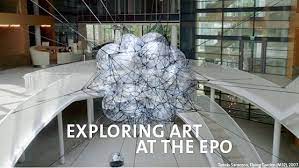
Exploring art at the EPO [Photo provided = European Patent Office (EPO)]
For the first time the European Patent Office (EPO) is unveiling its collection of international contemporary art the EPO art collection in the documentary entitled Exploring Art at the European Patent Office. The focus of the collection is on the dialogue between art science and engineering. Today having grown steadily over 40 years the collection comprises approximately 1000 works from almost all 38 EPO member states. On display at the EPO locations in Munich The Hague Berlin and Vienna the works feature in the new film. They bear testimony to the high value placed by the EPO on art in the workplace and reflect the diversity and wealth of European culture at the highest level.
Creativity is a key resource when it comes to Europe realising its innovative potential. And protecting and strengthening creativity is central to the EPOs mandate. For 40 years the EPOs growing art collection has reflected the continuous growth of Europes innovative spirit and continues to inspire staff today. The EPO is very proud to share its unique collection with the public. Offering access to these celebrated works of art expresses our determination to fight the effects of the pandemic including by overcoming the keenly felt absence of art in the public sphere caused by the restrictions EPO President António Campinos said.
The documentary presents over 50 works from the collection. It opens with the EPO film team visiting Tomás Saraceno who has participated in the Venice Biennale several times at his Berlin studio. The first of the six chapters that form the structure of the film is devoted to his large-scale installation Flying Garden (M32) housed in the foyer of one of the EPO buildings in Munich. Having himself registered several patents the artist personifies like no other the interface between artistic and technical innovation which is the focus of the EPO art collection. Under the heading of Network and knowledge transfer he talks about his installation which is suspended like a proton a neutron a multicellular organism explaining his ideas for a new approach to air heat and solar radiation.
The film goes on to show highlights of the EPO art collection by Heimo Zobernig Jonathan Monk and Sylvie Fleury. Furthermore the architect of the Munich headquarters Volkwin Marg (gmp architekten) explains the reason for choosing the site on the banks of the Isar just a stones throw from the Deutsches Museum and the German Patent and Trade Mark Office where the building completes a strikingly symbolic triad. Next the film takes viewers on a journey to Innsbruck to the studio of Thomas Feuerstein. The Austrian artist reveals his latest projects in which molecular processes play a central role. They trace possible real or fictitious developments asking where we are going as human beings as bodies but also as a society a political system and an economy.
Moving on we meet the Dutch artistic duo Liet Heringa and Maarten van Kalsbeek in their Amsterdam studio. It is they who are behind the multi-part ensemble in resin steel and ceramics that gives the cafeteria of the EPO building in The Hague its eye-catching distinctive atmosphere.
The fourth chapter looks at the EPO collection through the lens of geometry and light presenting a sculptural ensemble by Max Bill Beat Zoderers Coloured organ works by Brigitte Kowanz and Esther Stocker along with a snapshot of the Danish painter Malene Landgreen in her Berlin studio. All of these artists juxtapose order and chaos spatiality and planes construction and deconstruction to create their very own visual language.
Like Philippe Decrauzat and Katarina Löfström the Hungarian artist Péter Szalay contemplates space time and perception. Filmed in his Budapest studio he describes how he works with movement symmetry and sculptural volume and why he regards mathematics as an integral element of his art.
But what would art be in the absence of observers? The documentary concludes with Visual Vortex by Finlands HC Berg at the EPOs Munich headquarters and the series The Last Resort by the British photographer Martin Parr exhibited in one of the buildings in The Hague. In their ingenious yet very different ways both hold a mirror up to the audience and incorporate it into their work. Contemporary artists with a broad-based interest in sociocultural structures and connections play a pivotal role in the EPO art collection. After all in our visually saturated society pictures that make subtle statements about the world in a corporate context have an incomparable communicative power.
- Chapter 1: Network and knowledge transfer
- Chapter 2: Patents technology and international co-operation
- Chapter 3: The observation of nature
- Chapter 4: Geometry and light
- Chapter 5: Space time and perception
- Chapter 6: The beholder is part of the picture
- Chapter 7: One collection several perspectives
Website: : http://www.wip-news.com/news/articleView.html?idxno=6363