‘Intellectual Property Day’ The Special Meaning and the Last 10 Years Retrospect
The First Congratulatory Message Was Delivered from the President and Video Message was Sent from the Chairman of the National Assembly...
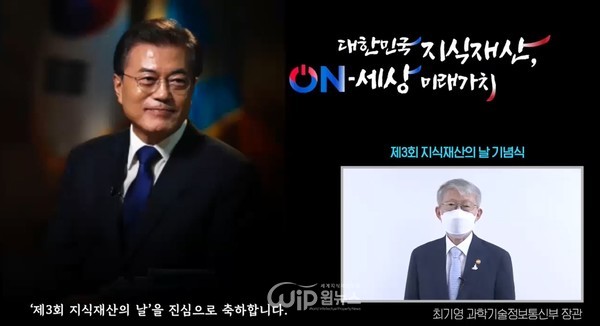
The presidents commemorative congratulatory scene was broadcasted online during the Intellectual Property Day ceremony
The 3rd Intellectual Property Day commemorative event was held on September 4 and it had a special significance. The presidents congratulatory message was delivered for the first time and the president of the National Assembly also sent a video message. The congratulations were made by the two heads of the executive and the legislative branch so the joy of being one in the field of intellectual property is beyond words. The reason for the establishment of “Intellectual Property Day” is to look back upon the past and go to the future so we will look back at the big things that have happened in the three fields of administration legislation and jurisdiction over the past 10 years.
Inauguration of the National Intellectual Property Committee and the role of former Director Go Jeongsik
Perhaps the biggest change in the administrative field was led by the former director Go Jeongsik. Since 2009 the former director Go Jeongsik has planned the governance to oversee and coordinate intellectual property policies including the enactment of the Framework Act on Intellectual Property and the establishment of the National Intellectual Property Committee etc. Since the National Intellectual Property Committee came out from the idea of the former director it would be natural to remember him on the day of intellectual property. The former director Go also contributed a lot to the Korean Intellectual Property Offices elevation to a world-class level.
The former director Go Jeongsik proposed a meeting of the heads of the patent offices of five advanced countries so-called “IP 5” allowing the international community to put the Korean patent administration in the top 5. Before IP 5 when patent offices of the United States Japan and Europe gathered to discuss international issues of intellectual property we had to catch up with them late. However by launching the IP 5 system we can respond to international issues at the same level as the patent offices of developed countries.
One more achievement would be a preemptive investment in human capital. For the first time he introduced the intellectual property professional graduate school system which laid the groundwork for companies patent attorneys and lawyers to increase their practical competency. Considering that making the system and operating is done by people he was setting a long-range plan in the field of intellectual property.
Korean World Patent (IP) Hub National Promotion Committee’ and Lee Gwanghyung the Vice President of KAIST
KAISTs Vice President of Academic Affairs Lee Kwang-Hyung established a fusion model for the first among domestic engineering colleges which was made between engineering and law by instituting the graduate school of intellectual property. Also he expanded to the highest level of intellectual property strategy (AIP) for the CEOs of small and medium-sized venture companies in Korea utilizing his experience in operating a graduate school of intellectual property. In addition to his enthusiasm and insight for nurturing talent another important achievement would be the “Korean World Patent(IP) National Patent Promotion Committee” which was launched in February 2015.
The Vice-Chancellor Lee Kwang-hyung served as a co-representative on this committee along with the National Assemblyman Jeong Gap-yoon of the Saenuri Party and Won Hye-young of the New Politics Alliance for Democracy. He focused on the “concentration of jurisdiction over patent litigation” which many people have tried several times in this committee but has not been able to achieve. The concentration of jurisdiction over patent litigation means that in the case of patent litigation that requires expertise which is different from general civil litigation should be gathered into one specialized patent court to handle litigation cases.
If the courts that have jurisdiction over patent litigation are consolidated into one place companies can get fast and highly specialized patent judgments so it has been considered very important in the scientific technology industry and industry. On the other hand the concentration of jurisdiction can shake the basic framework of the judicial system so there were many objections.
The vice-chancellor Lee persistently persuaded the national assembly. And he finally led the amendments to the law of civil procedure act and the court organization act in 2016 to focus on the concentration of jurisdiction. This incident has set a new milestone in the history of technological innovation systems which has accomplished an old homework that science and technology and industry have not been able to accomplish over the past 20 years.
The Assemblyman Park Beomgye Who Has Established a Damage Compensation System Suitable for The Era of Intangible Assets
The last person is Park Beomgye a member of The Minjoo Party(The Democratic Party of Korea) who revised the patent law to expand the scope of compensation for damages caused by infringement of the patent. Prior to the passage of the patent law initiated by the assemblyman Park the patent holder used to complain saying Even if you win the lawsuit the amount of compensation for damage will be too little.
For example suppose a patentee produces 100000 products. And an infringing company appears and reducing the number of products produced by the patentee to 80000. At this time even if the infringing company produced 1 million products the patent holder had no choice but to claim damages for patent infringement only for the number of production decreases due to infringement that is 20000 pieces. As a result there was a contradiction that the infringing company only compensated for 20000 damages and use the remaining 980000 patents for free.
The reason why the law could not be revised despite such contradictions was due to the stereotype that the principle of compensation for damages of the patent should apply the principle of the law of the compensation for damages on tangible assets such as land and buildings. Taking the law of compensation for damages on tangible assets as an example it is an interpretation that “if you lose a refrigerator that costs 1 million won you receive compensation for damages of 1 million won.” If the law of compensation for damages on tangible assets is applied to the calculation of compensation for damages for patent infringement even if the number of patent infringers productive capacity exceeds the patentees the excess quantity of infringers cannot be compensated for damages.
The amendment to the Patent Law initiated by Assemblyman Park Bumgye and passed the National Assembly in May 2020 improved this problem. A narrow interpretation of the meaning of this law means establishment of a compensation system which is suitable for intangible assets called patents and in a broad sense preparing the foundation to enter the era of intangible assets such as patents from the era of tangible assets such as real estate.
We look forward to giving thanks to more people on Intellectual Property Day which will be held around this time next year.
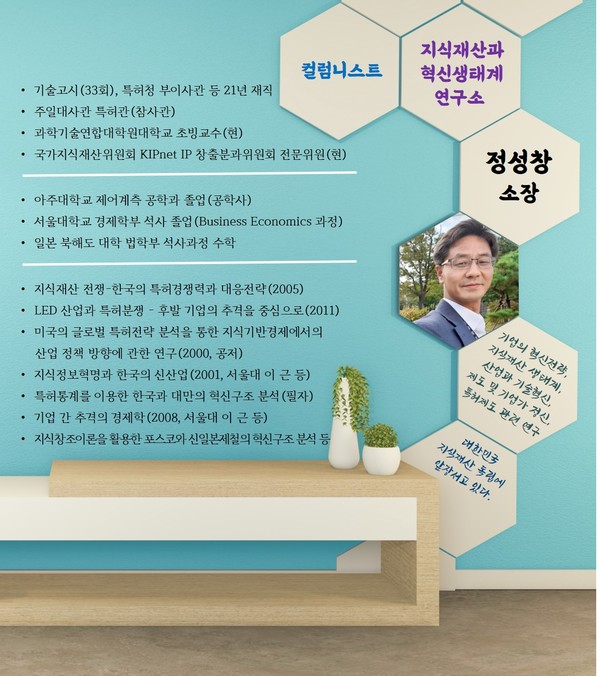
Director Jeong Seongchang
-Columnist
-Institute of Intellectual Property and Innovation Ecosystem
-Research on corporate innovation strategy intellectual propertys ecosystem innovation of industry and technology spirit of institution and enterprise research on patent system
-Leading the independence of Korean intellectual property
•Technical examination (33rd) worked 21 years as a vice-director of the Korean Intellectual Property Office etc.
•A patent administrator of Embassy of Japan(councilor)
•Visiting professor of University of Science&Technology(current)
•National Intellectual Property Committee KIPnet IP a subcommittee of creations specialist(current)
•Graduated from Ajou University Department of Control & Measurement Engineering (Bachelor of Engineering)
•Graduated from Seoul National University Faculty of Economics (Business Economics course)
•Masters course at the Faculty of Law Hokkaido University Japan
•Intellectual Property War-Koreas Patent Competitiveness and Response Strategy (2005)
•LED Industry and Patent Dispute-Focused on the pursuit of latecomers (2011)
•A study on the direction of industrial policy in the knowledge-based economy through the analysis of the global patent strategy of the United States (2000 co-author)
•Knowledge and Information Revolution and New Industry in Korea (2001 Seoul National University Lee Geun etc.)
•Analyze the innovation structure of Korea and Taiwan using patent statistics (author)
•Economics of pursuit between companies (2008 Seoul National University Lee Geun etc.)
•Analysis of the innovation structure of POSCO and New Nippon Steel Corporation using knowledge creation theory etc.)
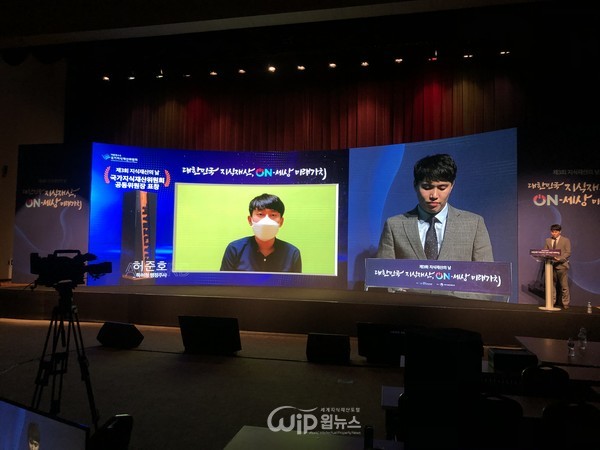
Photo of the site where the awards ceremony is being held to commemorate the Intellectual Property Day
Website: : http://www.wip-news.com/news/articleView.html?idxno=3386