Development of probe making fluorescence signal targeting cancer cells
Real-time fluorescence signal checkup on the tumor site by sensing tumor hypoxia Chosen for International Medicinal Chemistry journal ‘Journal of Medicinal Chemistry’ cover paper
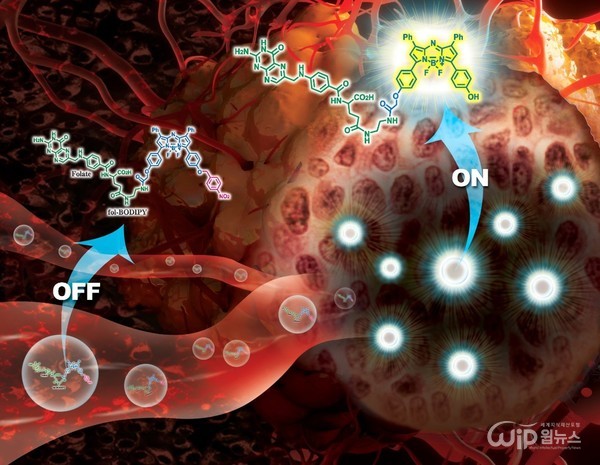
Principle diagram of near-infrared fluorescent probe. The probe radiates fluorescence signal reflecting the characteristics of tumor hypoxia while going around the vessels.
Hypoxia that causes lack of oxygen in the tumor area when the tumor gets bigger is known to be related to resistance of chemotherapy. As the probe that senses hypoxia and makes fluorescence signals by being accumulated only on tumor tissues selectively it makes us enable to discern the cancer’s location and shape more accurately.
* Probe: A molecular compound used for identifying protein or gene
Korea Basic Science Institute (President Hyung-shik Shin) announced on 23rd that dr. Gwan-soo Hong’s research team in Research Center for Bioconvergence Analysis developed the probe reacting specifically on tumors and making fluorescence signals.
The probes that have been developed so far have a threshold that they have low tissue penetration force and fluorescence signal sensitivity. Near-infrared fluorescent probe* developed by dr. Hong’s research team was designed to be activate its fluorescence signal in the high sensitivity in low-oxygen and target only tumor tissues selectively.
* Near-infrared fluorescence: A fluorescent light which is longer wavelengths than visible light and it is harmless to the human body and has good tissue permeability and self-emitting is a minimized wavelength area making it easy to use in clinical diagnostic technology.
Especially the probe developed this time not only can diagnosis cancer more accurately but also is available to use to check the fluorescent reaction of the probes injected into a body in real time during the surgical surgery and ectomy(resection) that is conservable the normal tissues as much as it can.
The structure of near-infrared fluorescent probe is an assembly of a tumor target a fluorescent substance and a hypoxia reactor. A tumor target sends the probe to the tumor tissues selectively and once a hypoxia reactor is boosted by tumor hypoxia a fluorescent substance emits fluorescence signals.
It is confirmed through vitro experiment and cellular experiment that fluorescence signals from the probe increases more than 20 times in hypoxia condition compared to normoxia condition. When the probe was injected through the intravenous injection to the animal model with cancer as the probe was accumulated on tumor tissues and the fluorescence signal was increased it was observed real time through biomedical optics imaging system.
The result of this research was published in the prominent international Medicinal Chemistry journal “Journal of Medicinal Chemistry” online edition on March 12 and selected as a cover paper in the recognition of its excellence in research.
Gwan-soo Hong the director of Research Center for Bioconvergence Analysis said “To improve the issues of a fluorescent cancer diagnostics probe that have developed so far we synthesized the optimized probes through international joint research and it is a research result that is embodied after going through the tactical verification stage in aqueous solution cells and animal model” and “Probe will be used in potential application fields such as real-time tumor diagnosis in body and accurate induction of surgical site.”
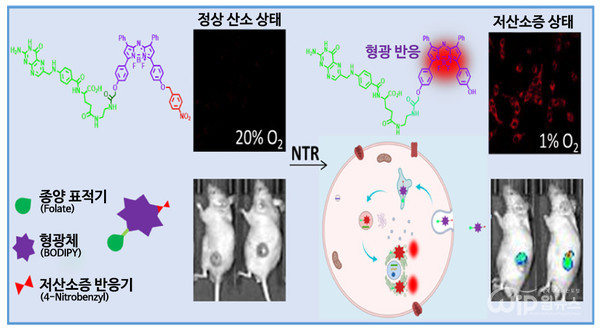
The structure and principle of near-infrared fluorescent probe
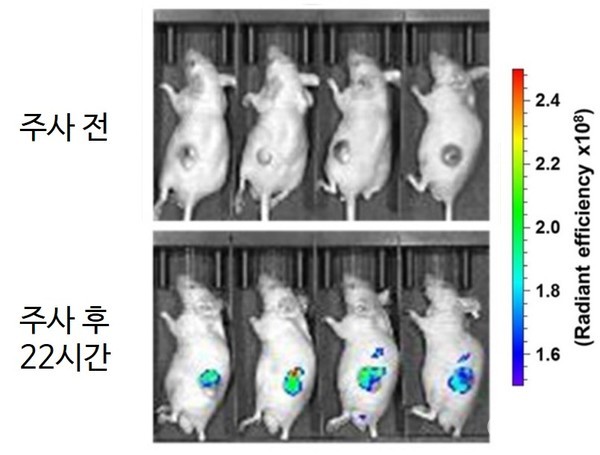
Fluorescent imaging of near-infrared fluorescent probe

KBSI research team
Website: : http://www.wip-news.com/news/articleView.html?idxno=6048