Development of VR display by professor Byoung-ho Lees team at Seoul National University more thinner as sunglasses
Using lens array reduces volume to 1/6 or less compared to conventional VR headsets Innovative technology of opening the new pages of VR devices by revising fitness · usage environment

From the left compare the existing VR optical system with the lens array VR optical system proposed in this research. Using a folding system for two-dimensional lens arrangement and optical path the volume of space required inside VR equipment is greatly reduced. [Photo provided = College of Engineering Seoul National University]
The College of Engineering Seoul National University(Kook-heon Char Dean) announced that professor Byoung-ho Lee and his team of Department of Electrical and Computer Engineering have developed a new VR display technology that can drastically reduce the size of VR(Virtual Reality) devices with large headset type on the 29th.
This research is expected to solve the problem of burdensome and uncomfortable fitness which has been the biggest obstacle to VRs popular expansion.
The reason why the volume of the conventional VR displays were big was because of the space inside. To reduce the thickness of this space the focal length of the VR optical lens must be reduced but for the Eye Relief which is the minium distance between the eyes and the lens there is limitation that too short focal length lens cannot be used. The research team started designing a new VR optics system that can overcome these limitation.
The Lens Array VR Display proposed by the research team is a structure in which a 2D lens array is inserted in addition to the conventional lens. A 2D lens array is an optical element in which small lenses are arranged in parallel. In the optical system structure the required space can be reduced by less than half as compared to the existing one since the actual focal length of the lens can be reduced while maintaining the eye relief distance as it is.
Also the research team applied the folding technique to control the polarization state of the light so that the light travels back and forth in the space of the optical system. As a result it has the same effect as securing a large enough area with only a short physical distance and the space required has been further reduced by one third. This reduces the volume to less than one-sixth. As a result the research team developed a VR optical system design that theoretically required only 3.3 millimeters of space.
The core of the technology is to make up for the inherent weaknesses of lens arrays and optimize them to have VR-friendly performance through Light Field analysis. The VR optical system design that the research team developed with a wide viewing angle of 102 degrees wide and 102 degrees long 8.8 mm wide eye box and 20 mm eye relief distance has excellent glass type VR display capability.
The research team unveiled a glasses-type prototype that is made of using Liquid Crystal Display(LCD) panel and Fresnel lens. This spectacle device is only 8.8 mm thick including the thickness of all necessary elements such as internal space LCD panel and Fresnel lens.
We will solve problems such as uncomfortable fitness and restricted usage conditions that has not solved for 10 years with the new glasses type VR display. and added I want to implement virtual reality and augmented reality hardware that can be wore like a real glasses in daily life by improving the performance such as resolution. said Ki-seung Park the first author of the research article. Professor Byoung-ho Lee said This is an innovative technology that opens up new pages of VR devices. This technology has been applied for an international patent and can be commercialized within 1-2 years if there is a company starting to produce products.
The results of this study are scheduled to be published on March 29 at IEEE VR a global academic conference in the field of virtual reality and were published on March 25 in the prestigious academic journal IEEE TVCG (Transactions on Visualization and Computer Graphics). The research was supported by the Ministry of Science and ICT and Institute for Information & communication Technology Planning & evaluation(ITP) for digital content source technology development.
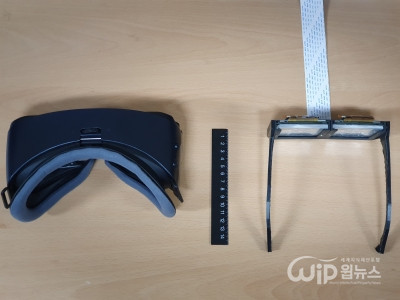
Comparison of VR display sizes. From the left the existing VR headset and glasses type VR display prototype developed by Professor Byoung-ho Lees team [Photo provided : College of Engineering Seoul National University]
Website: : http://www.wip-news.com/news/articleView.html?idxno=6047