Nitrogen oxide removed by high efficiency catalyst method operating in low temperature
Development of low-cost technology reducing ultrafine particles dramatically Enhancement of efficiency of Nitrogen oxide reduction in an extremely low temperature wide area temperature operating low energy type exhaust gas denitration technology Meeting both needs of reducing environmental facility operating costs and environmental regulations through improving energy efficiency
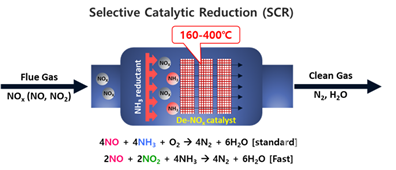
Concept map of the technology [Photo provided = Korea Institute of Energy Research]
The major source of ultra-fine particles in South Korea in which is selected as the first ranked country of pollution level of ultra-fine particles among OECD countries in 2019 is Nitrogen oxide from large business places such as power generation iron manufacture cement and petrochemistry.
While enactment of fine dust-related policies and special laws and standards for nitrogen oxide reduction has been gradually strengthening economical and efficient Nitrogen oxide reduction technology has been developed by domestic researchers.
Dr. Soon-gwan Jeong’s research team in Fine Dust Research Department of Korea Institute of Energy Research (KIER President Jong-nam Kim) developed wide area temperature operating low energy type exhaust gas denitration technology that can dramatically reduce output of Nitrogen oxide (NOx) in Selective Catalystic Reduction under 200℃ degree which is a causative agent of fine dust.
* Selective Catalytic Reduction (SCR): An advanced active emissions control environmental facility that turns N2 and O2 into harmless substances before emitting Nitrogen oxide (A common name of NO NO2. Harmful substance causes NOx acid rain and photochemical smog) generated using fossil fuel in the air (at the latter part of emitting).
High temperature of N2 and O2 generated in combustion facility such as power plants or steelworks react and generate Nitrogen oxide. Nitrogen oxide is a common example of environmental pollutant that causes smog acid rain fine dust and fatal diseases to human body so many countries including Korea regulate its output and the standard is getting strengthened.
Therefore combustion facilities in the industry apply environmental facility using Selective Catalytic Reduction method to turn Nitrogen oxide into harmless water and nitrogen. The main factor influencing the efficiency of Nitrogen oxide reduction is performance of exhaust gas denitration catalyst equipped on Selective Catalytic Reduction
As a commercial catalyst the catalyst (V-W/TiO2) that reactive metals like vanadium and tungsten dispersed by Titanium Dioxide (TiO2) is used. This commercial catalyst shows above 90% of optimal denitrification efficiency in the temperature area of 300-350℃ degree.
However in the most of industrial process Selective Catalytic Reduction system is located at the bottom of the equipment that removes dust and sulfur oxides in exhaust gas considering its management and stability. Drastically lowered exhaust gas by going through these preprocessing system flows into Selective Catalytic Reduction system below 200℃ degree and falls short of the degree for optimal denitrification efficiency.
Therefore to show optimal efficiency of Nitrogen oxide reduction in a commercial Selective Catalytic Reduction system additional process to re-heat exhaust gas up to 300-350℃ is essential. So operating costs is increased and additional Nitrogen oxide is emitted due to burning of fuel to meet the optimal temperature.
To reduce this inefficient energy consumption the team developed a denitrification catalyst that has endothelial toxicity against sulfur oxides and shows excellent vitality under 200℃ degree of temperature.
* Endothelial toxicity : Phenomenon that infinitesimal other substance flows into the catalyst and sticks or combines with the catalyst to reduce its vitality is called poisoning and endothelial toxicity means a fiber that endures this poisoning.
This is very challenging in Selective Catalytic Reduction research field the main factor of low temperature denitrification catalyst to show optimal efficiency is a development of catalyst that can lead maximization of vitality site of vanadium structure decline of moisture adsorption energy that reduces denitrification efficiency and reaction of FAST-SCR.
* Fast-SCR (Selective Catalytic Reaction): Reaction mechanism that improves reaction velocity by turning part of NO to NO2 among reactants in Selective Catalytic Reaction.
The team maximized the amount of reactive radical that can participant in denitrification by controlling vanadium structure which is a catalyst reactive radical through a development of new catalyst synthesis. In addition they developed the world’s class exhaust gas denitration catalyst showing 92% of denitrification efficiency in extreme low temperature of 180℃ degree by leading decline of moisture adsorption energy and FAST-SCR reaction through applying a promoter (a substance added to a solid catalyst to improve its performance in a chemical reaction) to prevent adsorption with moisture instead of ammonia reacting with the catalyst.
Low temperature denitrification catalyst forms ABS (Ammonium bisulfate) or AS (Ammonium sulfate) when waste of sulfur oxides react with ammonia reductant and moisture included in exhaust gas. The formed ABS has a problem which is declining vitality of catalyst and denitrification efficiency by covering cells and blocking smooth reaction.
However the new low temperature denitrification catalyst developed by the team is confirmed that it has excellent endothelial toxicity in the existence of sulfur oxides compared to commercial catalyst.
The new denitrification catalyst is able to be applied in various wide area temperature from 170 to 400℃ degree and does not need the additional exhaust gas re-heat process so it can save maximum 63% of energy. This is a low energy type technology that can reduce a burden of operating costs for environmental facility for small business owners as a response to the strengthening air pollution regulation and is responsible to environmental regulations.
There is no example of development of catalyst that shows denitrification efficiency over 92% in 180℃ degree area and it is an influential technology that can preoccupy domestic and international market through escaping high foreign dependency of domestic environmental catalyst and securing technological superiority in the field of low temperature catalyst which is an unexplored field.
The team is planning the catalyst production scale-up and module optimization research for pilot demonstration in the scale of 100Nm3/h to commercialize this technology. In 2023~2024 completing the pilot demonstration in this scale it can be applied to commercial plant facilities experimentally.
Seon-mi Hwang a senior researcher of Fine Dust Research Department said “It was able to secure low temperature denitrification catalyst technology by convergence of a variety of studies and immersion in research. In addition we will develop a technology that no one can match by challenging development of catalyst that has an excellent vitality below 150℃ degree which is a realm of dreams in the field of denitrification catalyst research.”
Soon-gwan Jeong the director of research said “The source of ultrafine particles can be removed economically and efficiently through the development of extreme low temperature denitrification catalyst which is considered as very challenging technology. This is estimated as an innovative technology that contributes towards domestic industrial fine dust reduction.”
Meanwhile this research is being conducted as a part of main project of KIER and multilateral collaboration with environmental companies is being proceeded. Furthermore 2 cases of original patent applications are completed through development of the technology and empirical study is going on for related spread of supply in the future.
Website: : http://www.wip-news.com/news/articleView.html?idxno=6042