Development of artificial neural tactile sensing system by imitating neural signals
Used Deep learning to classify fabric textures by 99% / Same predictability as humans based on learned signals
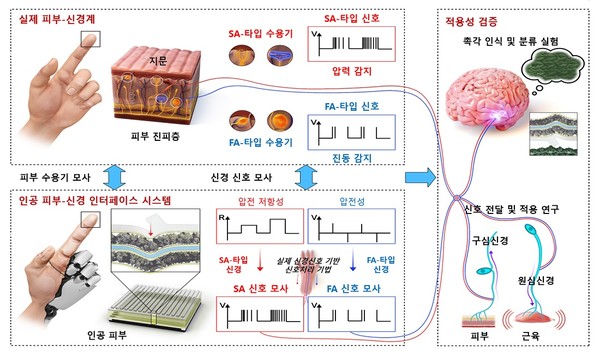
Artificial neural tactile sensing interface system based on human skin and neural system 출처 : WIPNEWS(http://www.wip-news.com)
A research team lead by Professor Park Seong-jun of Department of Bio and Brain Engineering of KAIST invented an artificial neural tactile sensing interface system based on human skin and neural system under joint research with research teams of Cheon Seong-woo of Korea University and Kim Jong-seok of Hanyang University.
The results were published in the international journal Nature Electronics on June 3 2021 as ‘Artificial Neural Tactile Sensing System’.
The system could be applied in fields like virtual/augmented reality metaverses artificial skin for burn patients and robotic arms/legs. It was difficult to make like real sensory organs due to the complexity of the systems and theory to implement. In particular humans accept tactile sensations by combining information such as pressure and vibration detected by various receptors making it more difficult to implement a complete artificial sensing system.
To solve the problem the research team manufactured a nanoparticle-based composite tactile sensor and connected it to a signal conversion system based on actual neural patterns. By the combination the research team succeeded in implementing an artificial system operating under a similar process to human tactile recognition processes.
The research team first produced electronic skin made of a combination of piezoelectric materials and piezoelectric resistant materials. The sensor can simulate both slow adapting type mechanoreceptor and rapid adapting type mechanoreceptor by combining nanoparticles in equivalent ways. The electric potential generated through the sensor is converted into a pattern of actual sensory signals through a circuit system. To simulate the actual process as close as possible real nerves were extracted and the signals emitted are functionalized.
The system was applicated to animals and signals were transmitted without distortion in the body and sensory signals such as muscle reflexes were realized. Furthermore Deep learning applicated fingerprint structured sensory systems can not only classify the texture of 20 types of fabrics by more than 99% but also predict them equally based on learned signals.
Professor Park said that the research is the first to actualize an artificial system imitating human system. He also added that the research can be a foundation for realizing more exquisite senses and the technique applied could make synergy with other types of sensory systems.
Website: : http://www.wip-news.com/news/articleView.html?idxno=7649