Virtual drug screening technology finds candidates of coronavirus 19 treatments
Establishing foundation technology that can quickly respond to new viruses
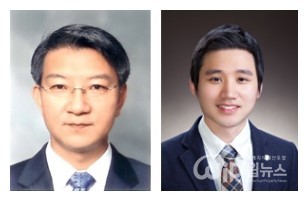
From the left Lee Sang-yup Distinguished Professor and Vice-President for Research Doctor Chang Woo-dae [Photo provided = KAIST]
Joint research team of Lee Sang-yeop Distinguished Professor and Vice-President for Research of KAIST Department of Chemical and Biomolecular Engineering and Doctor Kim Sung-taek of Institut Pasteur Korea announced that they repurposed drugs for COVID-19 treatment by virtual screening at 8th of the month.
The research was published on ‘Proceedings of the National Academy of Sciences (PNAS)’ online on July 7 under the name ‘Drugs repurposed for COVID-19 by virtual screening of 6218 drugs and cell-based assay’
COVID-19 is a global pandemic which is seriously damaging the human health. Remdesivir sold in the name of Veklury is clinically used under permit of U.S. Food and Drug Administration (FDA) but is not showing drastic results. It does not decrease the mortality rate but only decreases the recovery period by five days. Also it requires an intravenous injection of several days which does not fit on a pandemic situation. There was an urgent need of oral medicine that dramatically decreases both the mortality rate and recovery period.
The research team of Lee and Kim tried to repurpose drugs for COVID-19 by virtual screening.
Repurposing drugs refers to finding new indicants from FDA approved drugs or drugs ongoing clinical progress. The strategy can shorten the time required for development of new drugs which is suitable for pandemic situations like COVID-19.
Chang Woo-dae of KAIST Department of Chemical and Biomolecular Engineering built a virtual library of 6218 drugs which are consisted of FDA approved drugs or under clinical progress. Since it is time-consuming and expensive to verify all these drugs by experiment computer-based virtual screening technology that can quickly screen potential drugs as virus treatments was used as a substitute.
Conventional docking simulation based virtual screening technology had a high false positive rate which resulted a low hit rate. The research team implemented structure similarity analysis module and interaction similarity analysis module before and after the docking process and successfully increased the accuracy of the virtual screening. The technology realized a fast and accurate search of potential drugs by utilizing the drug-protein complex structure.
The research team also developed an algorithm that automatically produces an active structure of nucleotide analogue based prodrug which is mainly used in virus treatments. The prodrug shows medicinal effect as it is changed to an active structure after undergoing human metabolism. Therefore prodrug structures must be changed into active before going through a docking simulation. The team successfully produced active structures of nucleotide analogue based prodrugs including Remdesivir improving accuracy of the docking simulation.
The team sorted out 15 kinds of 3CL hydrolases and 23 types of RNA polymerases that is essential to the reproduction processof SARS-CoV-2 using virtual screening platform.
In vitro SARS-CoV-2 contaminated Vero cells of monkeys were used and 7 out of 38 drugs showed anti-virus activity. Calu-3 cells were used to make further verification of the 7 drugs and 3 drugs showed anti-virus activity. The candidates were omipalisib which was undergoing clinical progress for idiopathic pulmonary fibrosis tipifarnib which was under clinical progress for cancer and progeria and emodin for anti-cancer also undergoing clinical progress. Especially omiplisib was anti-virally 200 times more active and tipifarnib showed similar activity compared to Remdesivir.
Preclinical trial is needed for drugs that have shown anti-viral effects on cellular level for approvement. The team evaluated effects of a drug from the candidates under the preclinic support project of the Ministry of Science and ICT. A following clinical trial is planned since it showed toxicity in animal. The research for balancing toxicity and therapeutic concentration and preclinical trials for other candidates is also in schedule.
The team said that a superior virtual drug screening platform was built and this reduced the period for searching high potential candidates.
Lee said that the research established foundation technology that can respond quickly to new viruses and he wishes to develop technology that can deal with other kinds of viruses.
The research was conducted under the KAIST COVID-19 Science and Technology New Deal Biomedical technology development project supported by the Ministry of Science and ICT.
Website: : http://www.wip-news.com/news/articleView.html?idxno=7646