Biosensor sensitivity drastically improved after imitating features of human epidermal membrane
Ion density controlling feature applied to improve detectability / May be expanded to medical disinfection and environment
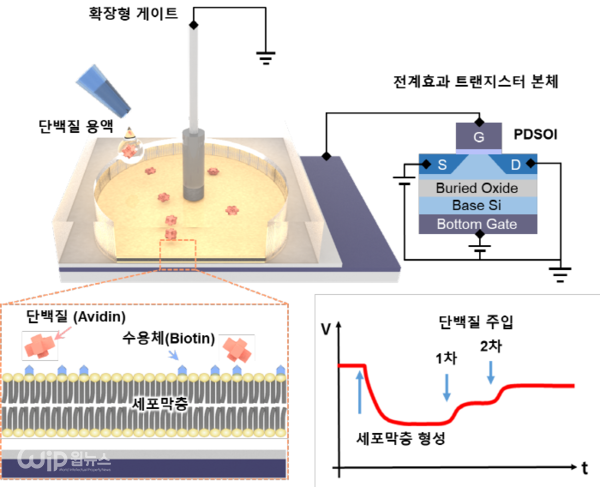
Molecule detection mimetic diagram of the technology developed by KIST and KU [Photo provided = KIST]
A Korean research team developed technology imitating features of human epidermal membrane that drastically improves biosensor sensitivity. Korea Institute of Science and Technology (KIST President: Yoon Seok-jin) announced that the research team of Doctor Yoo Yong-sang of Brain Science Institute and Doctor Kim Cheol-ki of Sensor System Research Center developed molecular detection technology utilizing electric signal that improves sensitivity of Field Effect Transistors (FET) by conducting joint research with the Korea University (KU President: Chung Jin-taek) research team of Professor Ahn Dong-june of Department of Chemical and Biological Engineering.
It was difficult to commercialize FET based molecular detection technology utilizing electric signal even if it was able to detect virus protein and DNA. It is because the molecule detecting area becomes thinner as the ion and charge density of the solution increases.
For example a drop of blood had detectable area of 1nm which is thinner than the molecule aimed to be detected. The researchers made various efforts such as diluting the solution but it did not work well.
Human epidermal membranes offered idea to overcome such obstacle. The membrane controls ion density inside and outside of the cell and restricts high density ion to get in the cell. The researchers spread the membranes on the detection chips and found out that no other preprocessing was needed to improve the technology.
The technology was named as ‘Lipid-FET’ which is more sensitive than conventional sensors and is capable of detecting specific molecules without diluting the solutions. The technology is showing the best performance among existing sensors and it may also be expanded to areas like virus microplastic medical and health care environment etc.
Yoo said that the technology developed by various researchers of IT NT and BT can be applied to any sensors that utilizes electric signals. He added that it may be applied to areas like dementia Parkinsonism diabetes COVID-19 Bird Influenza etc. Ahn wished the technology to improve the overall quality of life of humanity by solving various problems.
The growth rate of domestic dementia patient is 16% and 1 out of 10 elderly people older than 64 years old is suffering from it. The technology may contribute to early diagnosis of dementia Parkinsonism diabetes and similar diseases.
The research was supported by the Ministry of Science and ICT (Minister: Lim Hye-sook) and was conducted as a part of KIST core project KU-KIST project KIST medium-sized research support project and future material discovery project. The result was published in the newest issue of ‘Nature Communications’ a magazine of authority.
Website: : http://cms.wip-news.com/news/articleView.html?idxno=8318