Typeface (Or a type font) is protectable under the United States’ design patent laws
Kent A. JORDAN Judge of the United States Court of Appeals for the Third Circuit “Design patents for typeface must meet the same patentability requirements as any other protectable design”

Kent A. JORDAN Judge of the United States Court of Appeals for the Third Circuit
The 2020 International IP Court Conference an international exchange event of the professionals in the IP field consisting of five sessions which are status of international trials high technology and patent eligibility major issues in design litigation cross-border patent infringement and mock trials has been ended successfully on November 12.
In the session 3 the fourth program in the conference the discussion on ‘Major Issues in Design Litigation’ enacted among the speakers from the U.S.A. Korea Japan the UK and China.
Kent A. JORDAN attending through online was appointed in 2006 to serve as a United States Circuit Judge for the Third Circuit by President George W. Bush. Before the appointment he worked as a district judge in District of Delaware Court for 2002-2006. He received a Bachelor of Arts (B.A.) in Economics in 1981 from Brigham Young University and a Juris Doctor (J.D.) in 1984 from Georgetown University. After that he worked as a law clerk for Judge James L. Latchum of the Delaware District Court and as a lawyer specializing in intellectual property and business at Wilmington Law Firm in Delaware before becoming a judge.
Q : Can a typeface be registered as a design in your country? If so what is the legal basis? What are the standards to determine similarity of typeface designs in your country?
A : Yes typeface (Or a type font) is protectable under the United States’ design patent laws. In fact the very first United States design patent issued in 1842 covered a typeface designed by George Bruce. The USPTO even published a shout out to Mr. Bruce on Twitter for his design patent 175 years after issuance. “[T]ypeface is typically defined as a set of letters numbers or other symbolic characters whose forms are related by repeating design elements consistently applied in a notational system and are intended to be embodied in articles whose intrinsic utilitarian function is for use in composing text or other cognizable combinations of characters.” So design patents can offer broad protection for typeface protecting any ornamental characteristics of a set of letters or other characters beyond their utilitarian function that function being that they convey language.
Design patents for typeface must meet the same patentability requirements as any other protectable design. Notably though design patent protection for typeface has contributed to some of the shift in how the United States defines an article of manufacture. As I previously discussed design patents only apply to articles of manufacture meaning physical products that were human created. In the late 19th century when typeface design patents were more often utilized a typeface was cast in metal making it easy to identify the physical article of manufacture. But nowadays typefaces are often digital and applied through some computer program. Despite that typefaces applied through computer programs can still overcome the requisite hurdle for articles of manufacture today. In fact while the United States Patent and Trademark Office originally rejected electronic designs for failure to meet the “Article of manufacture” requirement it reversed its position in 1996. Specifically the USPTO issued guidelines clarifying that while “Type fonts have traditionally been generated by solid blocks from which each letter or symbol was produced” type fonts do not fail “To comply with the ‘article of manufacture’ requirement on the basis that more modern methods of typesetting including computer-generation do not require solid printing blocks.” 17 And after seeking public comment on its guidelines for examination of design patent applications for computer-generated icons the USPTO determined that a “Design for a computer-generated icon which is embodied in an actual article of manufacture is statutory subject matter for a design patent under Section 171.”
This conference held on November 12 2020 was held at the Grand Hyatt Hotel in Seoul under the theme of Court IP and Globalization with the method using parallel online and offline to prevent the spread out of Covid 19.
Focusing on IP5 which are United States China Japan and Germany about 300 IP related professionals from 8 nations around the world participated online and offline to share and progress IP issues with various cases.
The 2020 International IP Court Conference was ended in great success raising the status of the IP international trial in Korea covering five sessions and mock trials.

Photo of participating the live venue
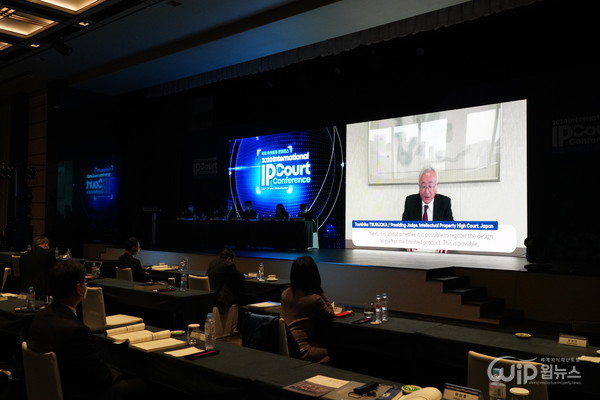
2020 International IP court conference photo
Website: : https://www.wip-news.com/news/articleView.html?idxno=5913