Development of material which is for enhancement of batterys life span that has high capacity for next generation
Development of lithium material suited for mass production and stabilization of battery performance

(From left) Department of Materials Science and Engineering professor Eun-ae Cho and Dr. Yong-ju Lee [Photo provided = KAIST]
The main cause that hesitate us from buying a car is that the mileage is short to drive with only one charge. To lengthen the mileage the battery has to be loaded much more but it causes the problem that increase the price and weight of car body. According to the reason the development of battery which has high capacity lengthening mileage with storing much more energy in the same weight is needed.
KAIST Department of Materials Science and Engineerings professor Eun-ae Chos research team announce that in comparison to cathode material battery that is currently used they has developed high density of energy over 20% anode material lithium that has high capacity and stability.
High-Ni anode material that has much content of nickel is currently used in electric vechicle battery. The battery anode material is an oxide of cobalt (Co) nickel (Ni) and manganese (Mn) and the higher content of nickel is in itthe capacity(200mAh/g) is higher. However the High-Ni anode material is showing limitations in improving the mileage and the research team proposed a lithium-excessive anode material as an alternative to the High-Ni anode material.
The lithium-excessive anode material is a next-generation anode material containing an excessive amount of lithium and its usable capacity reaches 250mAh/g due to the large amount of stored lithium which can store 20% more energy than existing High-Ni anode materials. However in the case of the lithium-excessive anode material a reaction occurs in which oxygen which constitutes the oxide becomes gas and is irreversibly extracted between the first charging and discharging. Therefore it can not be used since the oxide cathode material structure collapse and the efficiency of the battery rapidly decreased.
Professor Eun-ae Chos research team succeeded in improving the stability of the lithium-excessive anode material by developing a technology that selectively doped vanadium (V) ions on the surface of the anode material where irreversible oxygen reaction occurs mainly. While the lithium-excessive anode material has a low reversibility of 69% at the first charge and discharge the vanadium-doped lithium-excessive anode material exhibits a high reversibility of 81% at the first charge and discharge and even after 100 cycles of charging and discharging the stability up to 92% was confirmed.
Professor Eun-ae Cho explained The doped vanadium ions changed the electronic structure of oxygen ions in the anode material enabling reversible oxidation and reduction reactions during charging and discharging. and added The whole process was relatively simple so it is suitable for the mass production.
The research results in which Dr. Yong-ju Lee of the Department of Materials Science and Engineering participated as the first author were published in the online edition of Advanced Science on January 29 a renowned international journal in the field of materials (Name of thesis : Promoting the Reversible Oxygen Redox Reaction of Li-excess Layered Cathode Materials with Surface Vanadium Cation Doping).
Meanwhile the research conducted by Professor Eun-ae Chos team was supported by the mid-level research project promoted by the National Research Foundation of Korea and the KAIST Global Singularity Research Project.
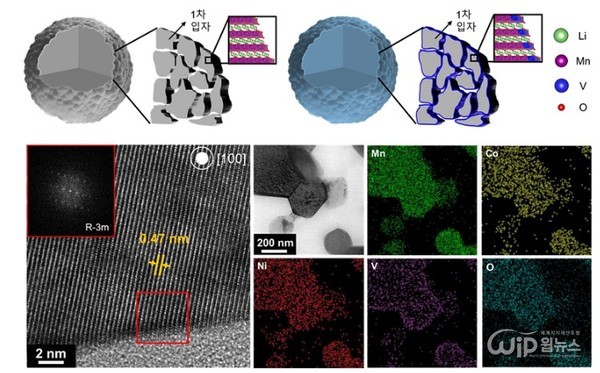
Schematic diagram of before and after vanadium ion doping and microscopic image and composition for distribution of anode material [Photo provided = KAIST]
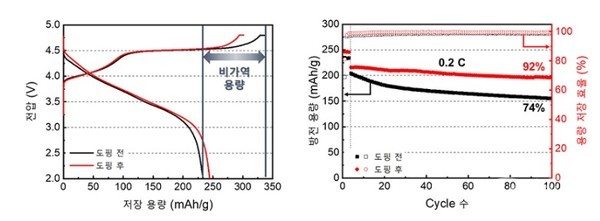
Irreversible capacity difference and efficiency of cycle life due to oxygen reaction of anode material before and after vanadium ion doping [Photo provided = KAIST]
Website: : http://www.wip-news.com/news/articleView.html?idxno=5554