Planned Entrepreneurship is on the Rise Instead of Professor-Led Startups
2024 KAIST Entrepreneurship Co-Growth Fair Held in the First Half of the Year KAIST-Mint Venture Partners MOU Signed Special Lecture by Former Samsung Hospital Chairman Song Jae-hoon Draws Attention
The 2024 KAIST Entrepreneurship Co-Growth Fair aimed at spreading the entrepreneurship culture at KAIST and promoting co-growth was held on the afternoon of the 4th in the lobby on the first floor of KAIST K1 Building.
This event now in its third year provides students interested in entrepreneurship with diverse and excellent information on KAIST startup companies and opportunities to work for startups that match their aptitudes. It also offers companies the chance to promote themselves and secure outstanding talent suitable for their business.
KAIST Startup Research Professor Ahn Tae-wook expressed I hope this event becomes an opportunity for entrepreneurial students as well as masters and doctoral students and faculty students to learn more about the various startup companies.
In his video greeting KAIST President Kwang Hyung Lee stated This event is a venue to share the efforts and achievements made to commercialize KAISTs pioneering and top-tier technologies. He added I ask for your continued interest and efforts so that the diverse technology commercialization and entrepreneurial innovation at KAIST can continue.
The special lecture by Mint Venture Partners Chairman Song Jae-hoon that followed garnered a heated response from attendees as it covered the globally emerging planned entrepreneurship.
Chairman Song explained the current state of Koreas bio industry the venture studio model and the specific model pursued by Mint Venture Partners dividing his talk into three segments.
Dr. Jae-hoon Song (MD PhD) has held positions such as President of Samsung Seoul Hospital Business Management Group Chairman of CHA Bio Group and Dean of the School of Medicine and Graduate School of Medicine at Sungkyunkwan University. He is currently the Chairman of the Asia Pacific Infection Foundation and the CEO and Chairman of Mint Venture Partners.
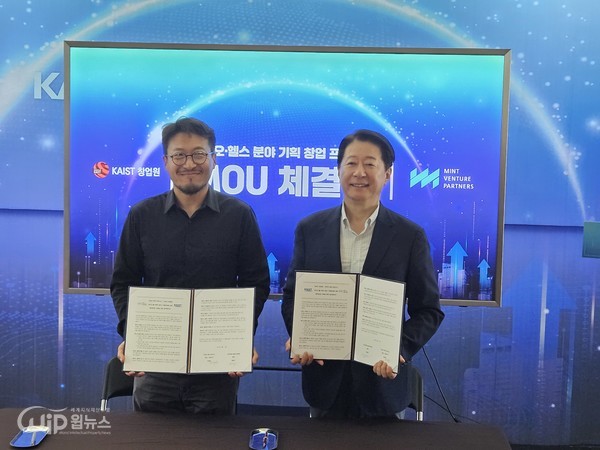
Following his lecture Dr. Song signed a Memorandum of Understanding (MOU) with Professor Bae Hyun-min of the KAIST Startup Institute to support the commercialization of bio-health technologies emerging from KAIST. The new form of startup entrepreneurship planned entrepreneurship is led by a new type of startup support institution known as the venture studio.
Summarizing Chairman Songs lecture:
The Korean government has identified the bio-health industry along with system semiconductors and future cars as the top three future industries. While system semiconductors are led by Samsung Electronics and SK Hynix and future cars by Hyundai Motors the remaining segment comprises the bio-health industry.
To revitalize the bio-health industry the government has introduced various regulatory innovation policies and plans to promote the industry through diverse innovations. One of these plans includes strengthening support for bio-health startups.
Additionally the Ministry of SMEs and Startups has a strategy to promote startups called Startup Korea with the ambition to become Asias top and one of the worlds top three startup nations. However considering the reality of competition with China this seems challenging.
In 2015 Chinese Premier Li Keqiang announced a policy for mass entrepreneurship and innovation urging all Chinese citizens to create startups. According to a 2019 Bank of Korea survey approximately 15000 startups are founded daily in China with a one-year survival rate of 70%.
Seeing Chinas progress Korea must reflect on its own situation. The Moon Jae-in administration commissioned McKinsey Consulting to examine Koreas startup ecosystem finding that regulations are too intricately intertwined. Resolving issues with the current system requires more than just the efforts of one department; significant reforms are necessary to achieve goals.
There are comments within Koreas startup investment industry that professor-led startups are being sidelined. This is not due to a lack of capability or skill among professors but because the structure forces professors to focus on R&D. To survive in the current structure one must not think of technology as equivalent to a business.
A business requires three essential components: the initial point of technology commercialization and startup support when the company is first established early-stage investment once the company is created and the final financial investment model in the later stages. Without these components a startup cannot succeed.
For Koreas startup ecosystem to thrive adopting the globally emerging standard of the venture studio could be the solution. A venture studio can handle various aspects including business planning product development investor networks fundraising marketing design operations and growth. Using a venture studio has been proven to accelerate fundraising performance.
Mint Venture Partners can be described as a global venture platform focused on nurturing startups and investing in bio-healthcare businesses.
As a venture studio Mint Venture Partners leads startup creation and technology incubation. It also acts as a strategic investor supporting startup acceleration programs and promoting startup growth through platforms like Virus HR and innovative medical sales programs.
Through this collaboration with KAIST our goal is to create startups based on innovative bio-healthcare medical technologies developed at KAIST contributing to disease overcoming by creating new diagnostic methods treatments and preventive measures. This is our goal and dream.