Public and Private Sectors Join Forces to Secure 100 Key Technologies for K-Shipbuilding
Joint Investment of 2 Trillion KRW in 10 Flagship Projects for the Future of K-Shipbuilding
The Ministry of Trade Industry and Energy (Minister Ahn Deok-Geun hereafter the Ministry) held the second K-Shipbuilding Tech Alliance at the eco-friendly ship equipment company Panasia. First Vice Minister Kang Kyung-Sung attended the event where the Ministry unveiled the “K-Shipbuilding Super Gap Vision 2040” outlining a long-term technology development roadmap for the shipbuilding industry.
Tech Alliance: A discussion body for future shipbuilding technology development composed of experts from academia industry and research sectors (launched in December 2023).
While Koreas shipbuilding industry boasts world-class manufacturing capabilities it has been criticized for lacking in key technologies such as ship engines and cargo holds and for its high dependency on foreign equipment. Recognizing the need to lead in future core technologies the Ministry collaborated with over 100 experts from academia industry and research including Chief Technology Officers (CTOs) from Korea’s top three shipbuilders to create a public-private joint roadmap for shipbuilding technology development through 2040.
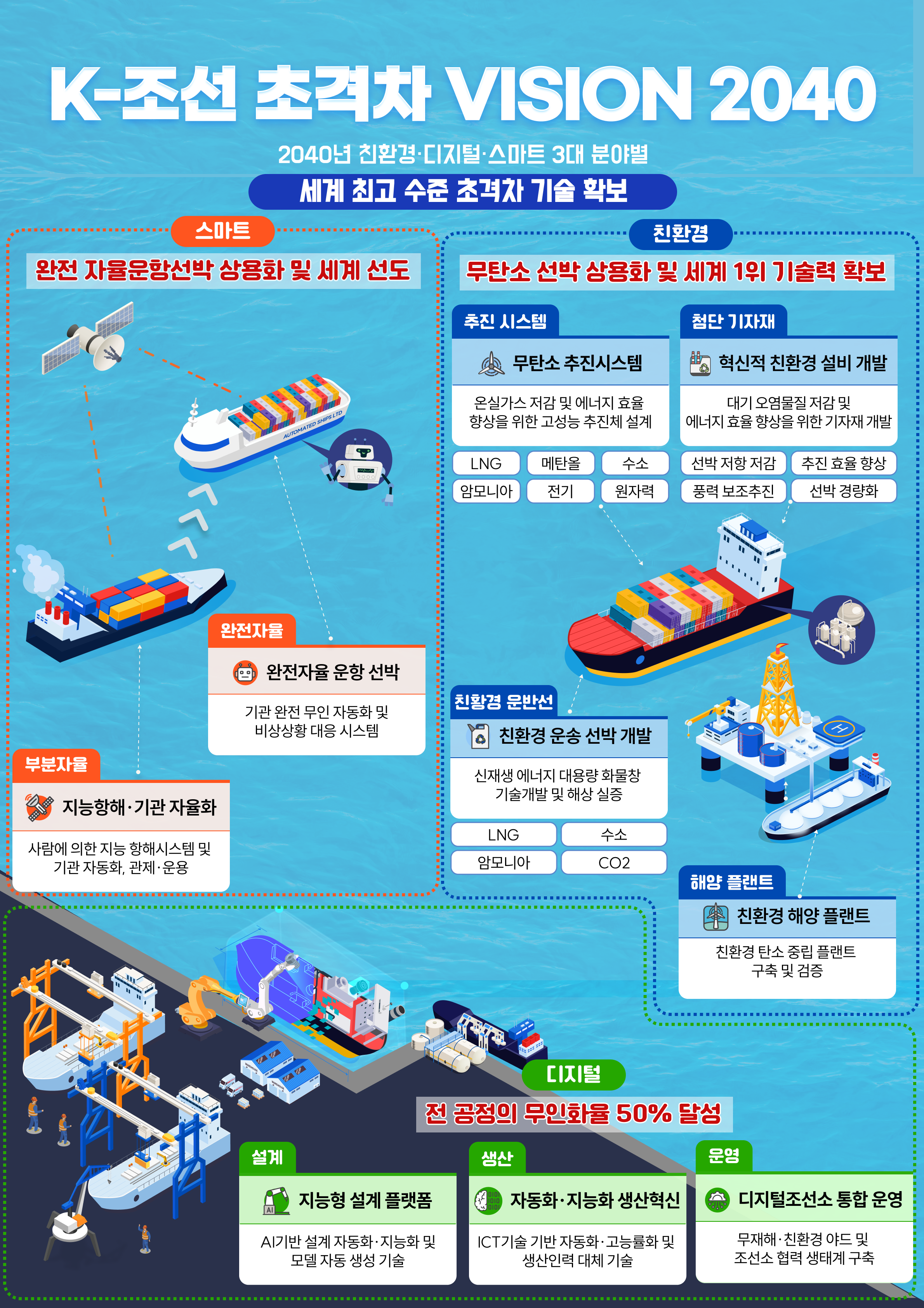
K-Shipbuilding Super Gap Vision 2040 Key Points
Under the vision of becoming the worlds leading shipbuilding technology powerhouse by 2040 the Ministry has set two primary goals:
Transitioning from a shipbuilding powerhouse to a marine engineering and equipment powerhouse.
Innovating from a labor-based shipbuilding system to an automation-based shipbuilding system.
The roadmap identifies 100 core technologies (351 detailed technologies) across three major areas—eco-friendly digital and smart—that the Korean shipbuilding industry must secure.
100 Core Technologies: Including hydrogen engines wind-assisted propulsion virtual training and unmanned safety navigation systems.
The current level of these 100 core technologies is assessed to be approximately 1.7 years behind leading nations such as the EU and the USA. Based on this evaluation detailed plans for securing technologies in each of the three major areas were developed:
Technology Gaps by Area: (Eco-friendly) 2.2 years behind the EU (Digital) 1.2 years behind the USA (Smart) 1.6 years behind the EU.
Eco-friendly: Aiming to complete a zero-carbon emission ship technology portfolio by 2040 developing eco-friendly fuel propulsion technologies such as hydrogen and ammonia and innovative eco-friendly equipment. Additionally efforts will focus on securing core technologies for liquefied hydrogen carriers and large electric propulsion ships including commercialization through maritime demonstrations.
Digital: Targeting a 50% automation rate in shipbuilding processes by 2040 securing automation technologies across all processes from design to production and yard operations. Initial efforts will prioritize developing welding and painting automation technologies and collaborative robot technologies for high-risk high-difficulty tasks. In the long term technology for fully automated ship block factories capable of 24/7 operation will be developed along with establishing test beds.
Smart: Striving for the commercialization of fully autonomous ships by 2040 securing technologies such as sensors equipment and integrated operation systems required for unmanned navigation. Development will also focus on technologies that support crew tasks with human-robot collaboration and safety technologies for emergency situations.
In addition to these areas the Ministry outlined 10 flagship projects that will drive the future growth of K-shipbuilding through 2040. Projects include ammonia-fueled ships liquefied hydrogen carriers shipboard carbon capture systems autonomous ship platforms and unmanned autonomous manufacturing processes. A minimum of 2 trillion KRW will be invested over the next decade by a public-private team to ensure these projects success and to secure new growth drivers for the industry beyond LNG carriers.
Moreover the government and the top three shipbuilders have agreed to jointly tackle four field-oriented technology developments to improve production efficiency through a memorandum of understanding (MOU). The priorities include:
Collaborative welding robots
VR-based training systems for workers
AI chatbots for supporting foreign workers in the field
Development of a collaborative production platform between shipbuilders and partners.
The successful implementation of these technologies is expected to enhance productivity and significantly improve workplace safety through efficient communication especially in shipyards employing many foreign workers.
Vice Minister Kang Kyung-Sung who visited Hanwha Ocean and Panasia to inspect safety management and address field challenges emphasized “If the public and private sectors secure super gap technologies together under Vision 2040 we can firmly maintain our global leadership in shipbuilding by 2040.” He added “As our exports have recorded the second-highest value for the first half of this year and have been positive for nine consecutive months the government will continue to support companies by alleviating investment challenges and proactively easing regulations to sustain this favorable trend.”
Website: : http://www.wip-news.com/news/articleView.html?idxno=24111